


If a Brand’s identity can be compared to that of a Person — or, more accurately, to a community of people who identify with it, experience it and talk about it — what happens when Artificial Intelligence also starts speaking on behalf of the Brand?
It is a question that is becoming increasingly relevant.
Artificial Intelligence is no longer simply helping companies produce content or make marketing activities more efficient. Increasingly, it is becoming directly involved in the relationship between Brands and people: answering customer questions, providing information, recommending products and services, managing conversations, supporting sales, and even representing the company autonomously.
In other words, AI does not simply talk about the Brand: in some situations, it speaks for the Brand.
This introduces a new element into the way we have traditionally thought about Brand identity.
Until now, it was primarily people — entrepreneurs, managers, employees, customers, influencers and communities — who contributed to shaping a Brand. Today, artificial systems can also participate in this process.
This new way for Brands to interact with people invites us to rethink the very concept of the Brand as a Person.
The Brand as a Person: what does it mean today?
To understand what changes with Artificial Intelligence, it is useful to take a step back and revisit the meaning of the concept of Brand as a Person.
A Brand is not simply the identity a company decides to build and communicate. Its identity also takes shape through the perceptions, emotions and experiences that people associate with the company, its products and its services.
The democratisation of communication brought about by digital media has made this process even more evident. People are no longer simply recipients of Brand communication; they actively contribute to shaping it.
A customer shares their experience.
An employee shares their point of view.
An influencer interprets the Brand through their community.
A professional talks about it through their own channels.
A review contributes to shaping its reputation.
Each of these actors can add something to the perception of the Brand, either reinforcing or challenging its identity.
It is in this context that a Brand can be compared to a Person who builds their identity not only through their own actions, but also through the relationships they establish and the way others perceive them.
And just as with a person, what matters is not simply what the Brand says it is. What matters is what it does, what it conveys and, above all, the experience people have of the Brand.
When Artificial Intelligence speaks for the Brand
Artificial Intelligence introduces a new way for Brands and people to interact: it can become a direct interlocutor, capable of answering customer questions, providing information, recommending products or services, and guiding them through the purchasing process.
An AI system can be configured to understand the Brand’s identity, adopt its values, tone of voice and interaction guidelines. It can therefore interpret the Brand’s personality, but it cannot build its identity on its own.
A Brand, in fact, does not express its values through words alone. It demonstrates them through what it does, the decisions it makes and the experiences it creates.
An AI interface may communicate closeness to the customer through a helpful and empathetic tone. But if, after that conversation, the customer experiences a slow or impersonal service, that experience will challenge the Brand’s promise.
AI can therefore give voice to the Brand’s personality, but the credibility of that voice ultimately depends on what the Brand is and does in reality.
This is where a new dimension of the relationship between Brand and AI emerges: when an artificial system becomes part of the customer relationship, it becomes part of the broader system through which the Brand takes shape and is perceived.
An example of this is Erica, the virtual assistant of Bank of America.
Launched in 2018, Erica has become a gateway to the bank’s digital relationship with its customers, supporting them with everyday banking activities, providing personalised information and insights, and directing them to a human representative when necessary.
What makes Erica particularly interesting from a Brand perspective is not simply the technology, but the way the customer relationship has been designed. Bank of America describes Erica as a kind of “personal concierge” and “mission control” for customers’ finances: an interlocutor that guides customers, helps them navigate their finances and provides personalised support.
Its name, the way it interacts and the personalisation of its responses all contribute to creating a recognisable Brand experience.
When an AI system becomes a consistent part of the customer relationship, it therefore becomes part of the Brand System and contributes to the perception customers develop of the Brand.
A Brand, many dimensions
To understand where AI fits in, we need to look at the system of dimensions and relationships that contribute to building a Brand’s identity.
A Brand takes shape through the interaction between what the company declares, what it offers, the way the organisation operates and the relationships it builds with people.
These elements are complemented by the different touchpoints through which the Brand interacts with its audiences and, today, by AI systems capable of interacting directly with people on its behalf.
It is through the interaction of these dimensions that Brand identity takes shape and Brand perception is built.
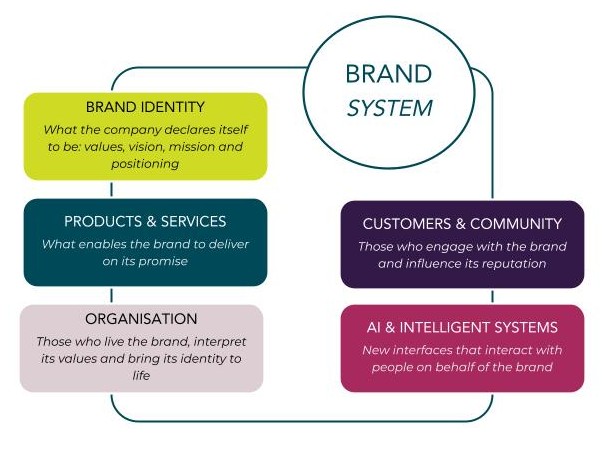
The Brand System encompasses several dimensions, each playing a specific role in shaping the Brand’s identity and perception:
- The company defines its values, vision, mission and positioning
- Products and services make the Brand promise tangible
- The organisation translates those values into everyday reality
- Customers and communities contribute to Brand reputation through their experiences and relationships
- Artificial Intelligence introduces new ways of interacting with the Brand.
To maintain a consistent Brand identity over time, these dimensions need to be managed in a coordinated way and continuously updated in line with market developments, business objectives and the Brand’s positioning.
Strong governance makes it possible to ensure that every touchpoint, including those managed by Artificial Intelligence, contributes to delivering an experience that is consistent with the Brand’s identity.
From Tone of Voice to Behaviour
When Generative AI becomes one of the Brand’s interlocutors, it is not enough to define how it should speak. We must also define how it should behave in different customer interaction scenarios.
What should it do when faced with a complex request? How should it handle a dissatisfied customer? When should it acknowledge that it does not have an answer? And when should it involve a human?
Cosa deve fare davanti a una richiesta complessa, come deve gestire un cliente insoddisfatto, quando deve ammettere di non avere una risposta e quando deve coinvolgere una persona.
The Vodafone case is particularly interesting because it illustrates this transition.
Vodafone has been using TOBi as a virtual customer service assistant for years. With the introduction of Generative AI, the company developed its evolution, SuperTOBi, to make interactions more natural and handle more complex and personalised requests.
For example, when SuperTOBi is unable to resolve a request, it can automatically transfer the conversation to a human agent while retaining the context of the interaction. The customer therefore does not have to repeat their request or start over, reducing one of the main sources of frustration in customer service interactions.
This is a technological feature, but it is also a customer experience choice: the limitation of AI is not passed on to the customer, but managed within the relationship. The technology recognises when it is no longer able to help and makes room for human intervention, while maintaining continuity throughout the experience.
It is precisely through these behaviours that AI can contribute to Brand Reputation: a seamless interaction that guides the customer towards a solution without forcing them to repeat their problem can strengthen the perception of a Brand as attentive, effective and customer-oriented.
For this reason, before entrusting AI with a direct relationship with customers, it is important to test it through realistic scenarios, assessing not only the accuracy of its responses but also the consistency of its behaviour with the Brand’s values and identity.
It is therefore not simply a matter of teaching AI to speak like the Brand, but of defining in advance how it should behave when speaking on the Brand’s behalf: which principles it should follow, how it should respond to different situations and when it should make room for human intervention. This behaviour must then be tested and refined through training and simulations based on real-world scenarios.
Conclusion
Artificial Intelligence does not change the nature of the Brand; it expands the ways in which the Brand can interact with people.
If, in the past, it was primarily people, the organisation, products, services and communication that shaped Brand identity, today an AI system can also become an interlocutor through which that identity is experienced, interpreted and understood.
This makes one distinction even more important: AI can give the Brand a voice, but it cannot give it authenticity. Authenticity depends on the consistency between what the Brand promises and what the company is, does and enables people to experience.
For those responsible for managing a Brand, the challenge is therefore not simply to determine what AI should say, but to ensure that it knows how to behave in a way that is consistent with the identity it represents. This means translating the Brand’s values, principles and personality into criteria capable of guiding new forms of interaction.
The Brand as a Person therefore remains a relevant concept, but it now takes on an additional dimension: technology can also become part of the relationship and contribute to shaping the Brand experience and perception.
And perhaps this is the most important question AI raises for us:
If we entrust technology with part of our relationship with people, what identity are we placing in its hands?
Do you want to develop an innovative marketing project? Contact Us


